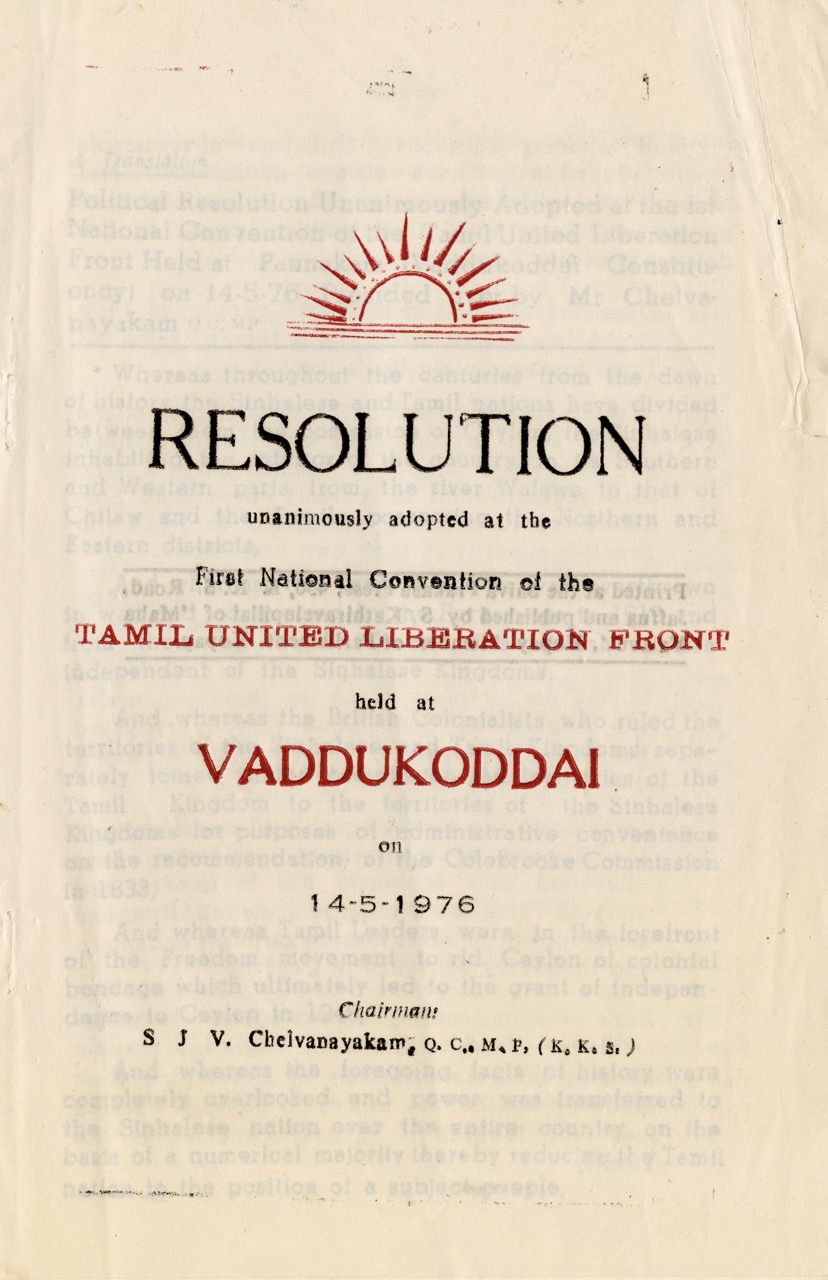
The liberation Movement does not need mere spectators. Let all of us become participants.
Delegates, members of the Tamil coalition, attendants, the great Tamil-speaking people, and youth,
We stand today at a most significant juncture in the history of the Tamil people. We, the Tamils living in Ilankai, have lived on this island even before recorded history. We have been here since the days when Sri Lanka and India were not separated by the sea but formed a continuous landmass. But for nearly two thousand five hundred years, the Sinhala people too have lived on this island. Even prior to that time, Tamils and Sinhalese belonged to two distinct ethnicities. That is to say, even before Vijaya came and laid the foundations of the Sinhala ethnicity, we were a separate ethnicity. When Dutugemunu and Ellalan fought in the second century before Christ, we were two ethnicities. When the Chola Empire invaded this island, we were two ethnicities. When the Europeans later arrived, we remained two distinct ethnicities — the Sinhalese and the Tamils.
We Exercised Separate Rule
When the Portuguese invaded in the 16th century, the Tamil Kingdom fought for its freedom independently, but succumbed to foreign military power. Even then, the Sinhalese living in neighbouring regions did not come to our aid, considering us a separate ethnicity and country. Eventually, the British brought the whole island under their control and in 1833, for their convenience, they merged the Sinhalese and Tamil nations under one administration. Even at that time, the Kandyan Sinhalese objected to being merged with the coastal regions. Yet today, with power over the entire island in the hands of the Sinhalese, the Tamils, the Tamil people, and the Tamil nation continue to suffer and decline under alien domination.
They are two different nationalities with different histories, territories, languages, religions, cultures and traditions.
The Truth of History
No one can deny this fundamental history. A map drawn in [1805] by Arrowsmith shows that the traditional homeland of the Tamils in Ilankai lies in the North and East. The Cleghorn Minute of 1797 clarifies this historical reality: “From the earliest times, the administration of this island was divided between two nationalities. First, the Sinhalese inhabit the interior, south and west from the River Walawe to Chilaw. Second, the Tamils possess the northern and eastern areas.”
By every criterion that defines a nationality , the Sinhalese and Tamil are two distinct nationalities even today. They are two different nationalities with different histories, territories, languages, religions, cultures and traditions.
A Shattered Dream
As mentioned above, these two people were first bound together by the British, Tamil leaders — from the time of Sir Ponnambalam Arunachalam — stood at the forefront of the independence movement. Even then, they suspected that living united with the Sinhalese might be fraught with danger. Yet, trusting Sinhalese leaders and desiring the unity of the island, they cooperated in the struggle for independence. Today, that trust appears as a great deception and a shattered dream.
The Dawn of Tamil Alliance
With the demise of English colonialism, Tamils demanded representation in which one ethnic group cannot rule the other with the power of franchise. This demand was presented by Tamils under the political leadership of the All Ceylon Tamil Congress. It was not granted and the Soulbury constitution was thrusted on the Tamils. Some of the Tamil representatives accepted this arrangement against the wishes of the Tamil people. These politicians were wiped out from the political scene by Tamils in the following elections. Believing that Tamil distinctiveness could not be safeguarded under a unitary system, some of us left the Tamil Congress and formed the Federal Party, seeking permanent safeguards within a federal structure. In 1972, this demand was rejected in the Constituent Assembly. Thereafter, all Tamil parties united to form the Tamil United Front and placed forward a six-point demand calling for constitutional amendments. We declared that if these were not meaningfully considered within three months, we would act on the basis of the right to self-determination. I must state here that the Tamil United Front was conceived in Valvettithurai and was born in Trincomalee — which the future will show as the capital of Tamil Eelam.
Confiscation of Rights
Because we sought to preserve unity and live with the Sinhalese as equals, today we have been reduced to a community that is being ruled over. Through legislation and administrative action, the Sinhalese government has steadily centralised power and deprived the Tamils of their rights. Promises and agreements made by Sinhalese leaders have been thrown to the wind. Citizenship, franchise, land rights, language rights, equality, religious rights, even autonomy and security — all have been gradually stripped away.
Tamils who settle informally for livelihood reasons face emergency laws, military action and punishment by the court of law.
Hill Country Tamils
For example, within six months of independence, the Indian-origin Tamils of the hill country were rendered stateless, despite assurances of equal rights and parliamentary representation. Thereafter, their voting rights were stripped off, eliminating their parliamentary representation. Today, they are being treated as domesticated animals and an agreement between governments made to decide the number of persons to be accepted by each government without any consent from Hill county Tamils. As the number of applicants for repatriation to India was lower than anticipated, the Sinhalese government disrupted their lives and brought them to the street to make a coercive repatriation possible.
Discrimination
In 1956, legislation was passed to make Sinhala the sole official language, depriving Tamils of linguistic equality. They use this legislation to rob or block all the opportunities from Tamils even today. Apart from this, the Sinhalese are encouraged to be settled in Tamil lands and this process is well organised through legal means. Yet Tamils who settle informally for livelihood reasons face emergency laws, military action and punishment by the court of law.
No Development
Today, the Tamils have no opportunity or place in employment or in business. Above all, under the guise of a so-called “standardisation” scheme — a deceptive and unjust policy — the education of the Tamil people is being undermined. By restricting the educational opportunities of the Tamil youth, the future of the ethnic group is being cast into darkness. If protests or movements are organised against these injustices, the Sinhalese police and military — and at times even Sinhalese mobs, at moments and places convenient to them — carry out violent atrocities, forcing the Tamil people to submit to a condition of subjugation. For more than four hundred years, Tamil Eelam did not experience development under foreign rule. The same situation exists even today. In these various ways, the Sri Lankan government has sought to shatter the life of the Tamil people, erase its distinct identity, and establish a form of hegemonic domination.
The Constitution is an Excluded Instrument
We conducted many movements and struggles to rectify these situations. We also entered into agreements with Sinhalese leaders. Furthermore, when we raise our voices that we would start a protest campaign in the coming months, some would call negotiation to undermine our enthusiasm and determination. We regret to say that some Tamils have also joined this. In the political situation we have reached today, no matter how the constitution is amended, it will be of no use because the next Sinhalese government will set aside the amended constitution.
You know the fate of the agreement we made with Bandaranaike. You also know the fate of the agreement we made with Dudley Senanayake. If we need to say more, where is the 29th Article of the Soulbury Constitution, which was determined by the Privy Council as an irrevocable clause, that provided protection to minorities? It has been thrown away and has disappeared.
Having considered all these, we, operating on the basis of the right to self-determination to assert our traditional sovereignty, demand that Tamil Eelam become a separate nation once again.
Why Tamil Eelam?
Such is the fate of any Sinhalese constitution that grants rights to Tamils. It will be the same in the hands of the next Sinhalese government. There can be no irrevocable, permanent protection for the Tamil people under any political system. Having considered all these, we, operating on the basis of the right to self-determination to assert our traditional sovereignty, demand that Tamil Eelam become a separate nation once again.
Kankesan Mid-Election
When the Sinhalese people established today’s new political system, most of us withdrew from the Constituent Assembly. You are aware that in the last general election, not a single Tamil was elected under the Sinhalese government’s policy. Nevertheless, at that time, the Sinhalese government claimed that a portion of the Tamil people would accept it. To test that claim and to inform the world that the Tamil people had rejected this new political plan, I resigned my parliamentary seat and contested the election again on behalf of the Tamil United Front. The Sinhalese government, after delaying the election for over two years and making all preparations to obstruct it, suffered a decisive defeat in that election.
The election demonstrated that the Tamil people rejected the Sinhalese political plan and, with that verdict, endorsed and insisted on the principle that Tamil Eelam must be an independent nation. I, too, accepted the mandate given by the Tamil people and pledged to work for freedom and liberation.
Non-Violence as Our Weapon
We are at our first convention of the Tamil United Front. At this historic moment, we affirm that we wish to live as siblings with the Sinhalese people. In the future, too, we hope to coexist in friendship. To solve this problem, the Eelam Tamil and Sinhalese nation must operate with a mutual friendship. To achieve this, we follow the path of non-violence shown by Gandhi. Some youth believe violence alone brings liberation. Yet without arms, trained forces, or foreign support, violence is neither practical nor ideal. A non-violent movement rooted in moral strength is both just and possible. It will require sacrifice and endurance. We have followed this path in the past to march forward our movements.
Around the world, youth are turning to violence in pursuit of justice. We know that some of our own youth are drawn to this path. I warn the government that imprisoning and torturing young people without inquiry only encourages such tendencies.