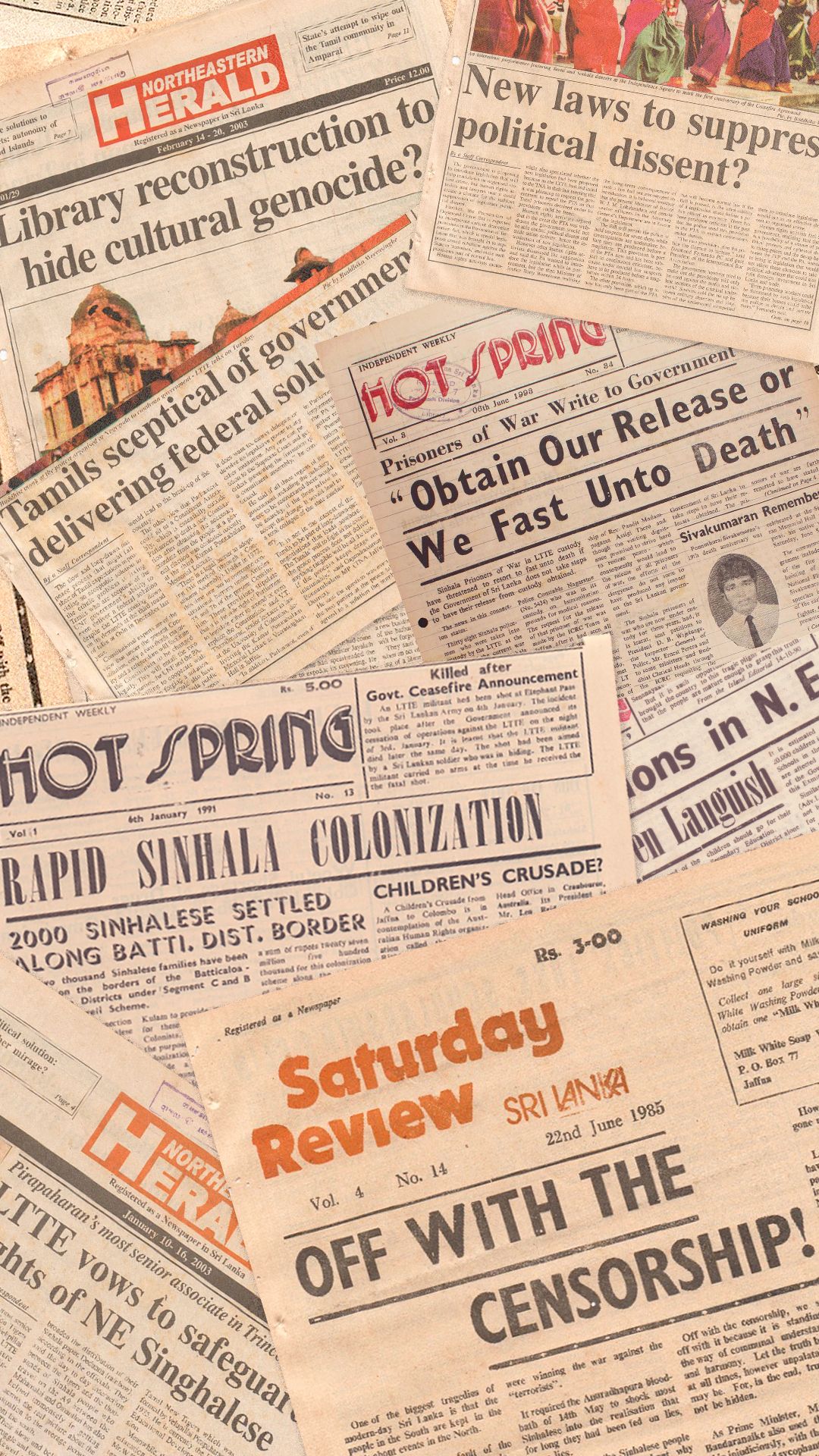
The following two pieces are an illustration of the discussions surrounding the temple entry movement as they played out in The Hindu Organ in 1956. We are reproducing them here not as an endorsement of the sentiments expressed, but as a means to provide insight into the conversations happening in the months preceding temples opening their doors to Panchamar (Dalit) castes.
The Importance of the Three-Pronged Struggle
20.05.1956
In a country inhabited by people of many races, if all political power falls into the hands of one section, particularly the majority race, it is not an unprecedented phenomenon in history for them to misuse their powers arbitrarily and seek to crush the minority race living there. It is precisely as a means of preventing this injustice that civilised countries with multi-racial populations have, in this modern age, adopted the federal principle of sharing political power, and have successfully established inter-ethnic harmony. Countries such as Canada, Switzerland, Yugoslavia, and Russia stand as concrete examples of this truth.
A minority race living in a country can be exterminated in two ways. One is to destroy them through violence. The other is to destroy them immediately and over a period of time by enforcing legislative measures. Since extermination through violence is regarded in this century as uncivilised and barbaric, the governments of majority communities tactfully employ the second method. There are three principal ways of destroying a minority race through legislation:
Depriving the minority people of their citizenship and voting rights.
Destroying the language of the minority people.
Occupying the regions inhabited by the minority people.
Some governments implement all three of these methods immediately through prompt legislative measures. Some governments carry them out gradually through long-term plans. Unless the minority community stands united in resisting all three of these afflictions, it cannot prevent its own destruction.
In order to eliminate the Tamil-speaking people, the minority race living in Ceylon, the late Mr. D. S. Senanayake immediately put into practice the first of the above three methods. By changing the law, he robbed, in an instant, the voting rights and citizenship rights of the Tamil-speaking people of the Hill Country. Without quickly and immediately employing the other two methods, he made arrangements to accomplish them through long-term clandestine measures.
Now Mr. Bandaranaike has undertaken to implement, through immediate legislation, the second method of destroying the language of the minority race.
The remaining third method, namely the carrying out of planned Sinhala colonisation in the Tamil areas, has been half accomplished and remains incomplete. There is reason to believe and expect that this too will be fully carried out very soon. If that is accomplished, even the fact that a people called the Tamil-speaking people once lived in this country will have to end as a falsehood and an ancient tale!
Therefore, if the minority Tamil-speaking people of Ceylon are to be protected, a struggle must be carried out so that all Tamil-speaking people living here may obtain voting rights and citizenship rights. The condition under which the Tamil-speaking people are regarded as doubtful citizens must be changed. A struggle must be carried out for the Tamil language to obtain equal status. A struggle must be carried out to prevent Sinhala colonisation from taking place in the Tamil regions.
We are pleased to observe that the only party actively engaged in and working vigorously in this three-pronged struggle is the Federal Party. It is only through this one party that there is a way for liberation to come to the Tamil-speaking people. Some Tamil-speaking people who sympathise with the leftist parties believe that the Lanka Sama Samaja Party is also fighting for these causes. Although it is true that they are struggling to a certain extent, their struggle is not going to produce an appropriate outcome for the Tamil-speaking people. Because the leftist parties conduct their struggle on behalf of the minorities on two fronts. They do not oppose Sinhala colonisation; it may even be said that they support it to a certain extent. Unless Sinhala colonisation in the Tamil areas is prevented, the struggle for the rights of the Tamil-speaking people will end as nothing more than a mere farce.
We shall examine how this is so next week.
Sinhala Colonisation
27.05.1956
Last week, we pointed out that, in order to protect the Tamil language, the Tamil-speaking people, and their arts, culture, traditions, and other heritage from being destroyed and wiped out in the island of Ceylon, the planned Sinhala colonisation in the areas inhabited by the Tamil-speaking people must be stopped immediately. Let us now examine why this is so.
Some people, who are unable to fully understand the harm that planned Sinhala colonisation will bring upon the noble Tamil race, begin to speak like benevolent and charitable men. They ask, “What if they are Sinhalese? They too are Ceylonese. Poor people, where else can they go? Is it not in the Northern and Eastern Provinces that there are vast stretches of land and forest suitable for settlement? If someone settles on land that is lying waste, what concern is it to us?”
When the government of the majority community plans to eliminate a minority community living in the country, the first measure it adopts is to break the political strength of that minority. With regard to the Tamil-speaking people of Ceylon, the late Mr. D. S. Senanayake carried out this first measure with great skill and succeeded.
When the first parliament met under the Soulbury Constitution, the Tamil-speaking people had 24 seats in parliament. Sixteen Tamil-speaking representatives from the Northern and Eastern Provinces and eight Tamil-speaking representatives from the Hill Country were members of parliament. Mr. D. S. Senanayake realised that if so many Tamil-speaking representatives raised their voices in parliament, it would be difficult to deprive the Tamil-speaking people of their rights and oppress them. He therefore introduced the citizenship and voting rights legislation affecting the Hill Country Tamils and rendered the Hill Country Tamil people without voting rights. Through these means, he contrived to ensure that eight of the Tamil-speaking representatives could not even set foot in Parliament. It was a curse upon the Tamil-speaking people that some Tamils, such as Mr. G. G. Ponnambalam, were also accomplices in this unjust scheme.
At present, there are 17 Tamil-speaking representatives in parliament—16 from the Northern and Eastern Provinces and one from the Puttalam electorate. The hidden objective of the planned Sinhala colonisation is to reduce this number further and completely destroy the political strength of the Tamil people.
Sinhala colonisation has taken place at Allai, Kantalai, and Gal Oya in the Eastern Province, and in the Vavuniya electorate in the Northern Province. In the general election held in 1947, not even a single Sinhalese contested as a candidate in any constituency of the Northern and Eastern Provinces. But what happened after Sinhala colonisation began in 1952? In the general election that was held, and in the by-election that followed, a Sinhalese candidate came forward to contest the Vavuniya electorate. In the general election held in 1956, the two Sinhalese candidates who contested in the Eastern Province received a considerable number of votes. In particular, in the Trincomalee electorate, where two Tamils and one Sinhalese contested, the Sinhalese candidate obtained enough votes to secure second place. If Sinhala colonisation continues, constituencies in the Eastern Province will very soon reach a stage where they send Sinhalese representatives to Parliament. Following that, many constituencies in the Northern Province may also come into this situation.
When the government of the majority community plans to eliminate a minority community living in the country, the first measure it adopts is to break the political strength of that minority.
It is for this reason that we believe the majority strength of the Tamil-speaking people in the areas where they live as the majority must be protected from being weakened. The Tamil-speaking people must bear in mind that if the Tamil majority there is reduced through Sinhala colonisation, the parliamentary representation of the Tamil-speaking people will also be reduced.