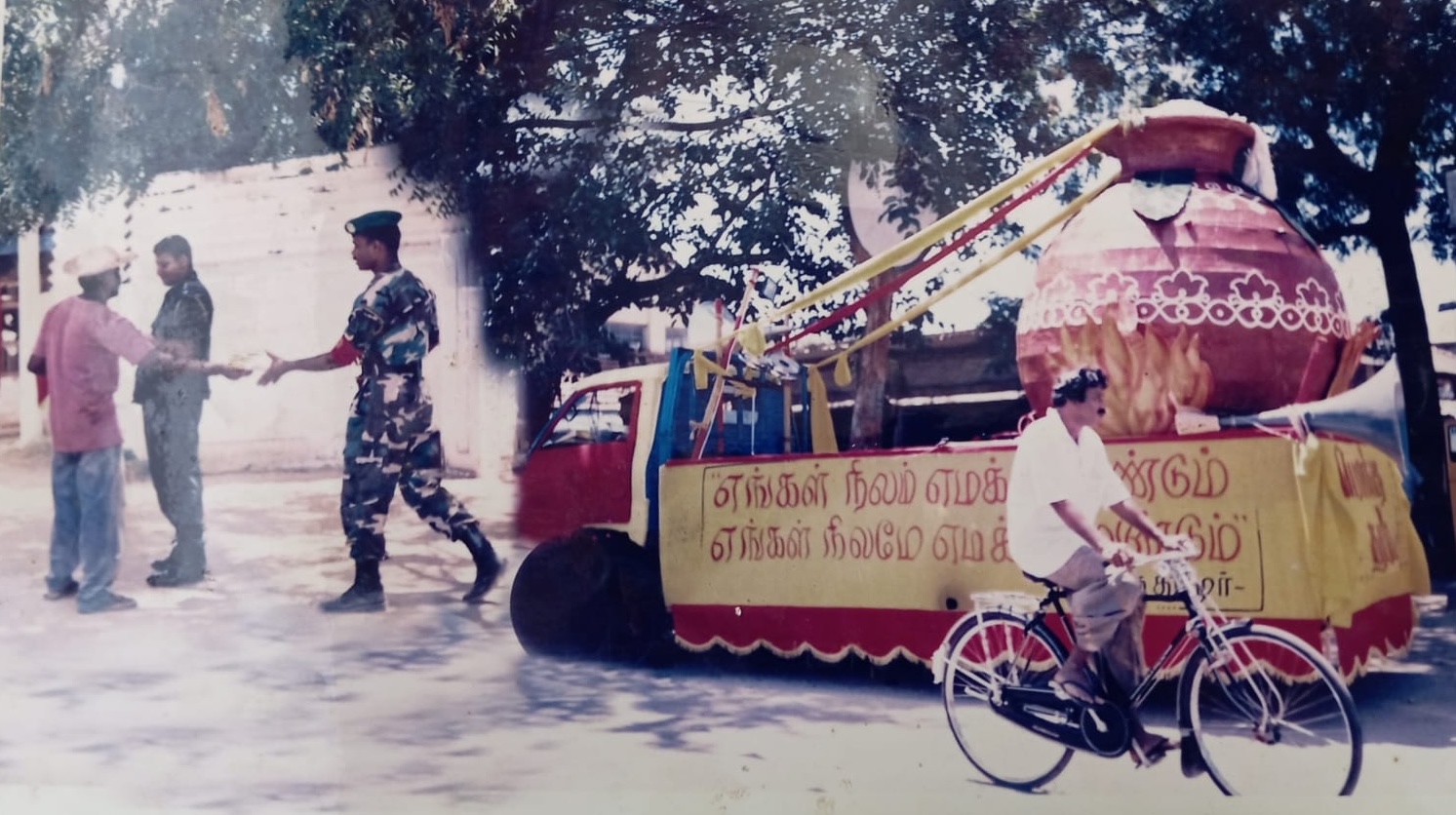
It was only after my first taste of their theatre workshops that I felt like I really knew the Sithamparanathans. We, the audience, stumbled over our first theatre exercises, running around a conference room and dodging chairs placed for silent listening to find our partners as Mrs Sithamparanathan counted down from 10. When she reached 0, the laughter rumbled off the walls, and the room pulsed with life. Soon we were dancing, our bodies moving to the rhythm of Dr Sithamparanathan’s voice as he sang into the microphone. In that moment, I experienced something that had always felt abstract: the energy of theatre as a space where people could release fear, connect with one another, and imagine something new.
Our following conversations left me in awe of their passion and dedication to the Tamil community. For decades, the couple have worked together through theatre as a form of cultural expression, political reflection, and collective healing.
Dr Sithamparanathan Kandasamy is the founder-director of Animators Theatre and co-founder of the Theatre Action Group. This work emerged from grassroots organising in the early 1990s, when thousands of people in the North were displaced from High Security Zones and forced to live in welfare camps. In those early years, their work focused on helping internally displaced communities rebuild trust, confidence, and solidarity through creative expression. But this work started long before this, with his plays, like Mann Sumantha Meniyar and theatre workshops in the early 1980s helping build political consciousness among the youth.
Mrs Pathmini Sithamparanathan, formerly a teacher at Chundikuli Girls’ School and later a Member of Parliament, worked closely alongside these efforts. Together they travelled across the North and East working with communities deeply affected by war. Through plays, music, movement, and workshops, they created spaces where children could laugh again, and adults could speak openly about trauma, fear, and hope.
Out of this work emerged one of the most powerful cultural movements of the early 2000s: Pongu Tamil, a mass cultural gathering that brought together hundreds of thousands of people through theatre, song, and political expression.
In the following conversation, the Sithamparanathans reflect on the political atmosphere surrounding the 1976 Vaddukoddai Resolution, the role of theatre in community healing, and how cultural movements like Pongu Tamil helped and can continue to transform fear into collective energy.

What was it like to live through the Vaddukoddai Resolution?
Sithamparanathan Kandasamy:
To speak about what Vaddukoddai meant to us, I need to tell you about what happened before. In 1972, I was 16. There was a political change in 1972, and a bill was brought in by the SLFP government, which included a constitutional change that gave special status to Buddhism and Sinhala as the sole official language. The papers reported the discussions between the United Front and the Illankai Tamil Arasu Katchi (ITAK) in such detail, what they were saying, what they were denying. We were all paying attention. Then, they denied all 6 of the drafts that ITAK suggested.
The new constitution was promulgated on May 22nd, 1972, and the days before, there was a meeting in Jaffna. The pavilion was filled with people, and there wasn’t any space for us to sit. I had to kneel just to hear Amirthalingam speak. When they announced a three-day hartal, the people around me started to clap like thunder. It was only then that we learned what a hartal was.
Those days before May 22nd, the whole Tamil people came together as a community. The stores were all closed, and transportation was brought to a stop. Just to watch it was a special feeling.
I was 16 at that time, and I would write on the walls. I remember one time clearly. It was the ‘“குடி அரசு அரசியல் திட்டம்“ (Kudi Arasu Arasiyal Thittam), and we would write “குடி எடுக்கும் அரசியல் திட்டம்” (Kudi Eddukkum Arasiyal Thittam) instead, as in, this was a plan to destroy our community, so we wrote it to rhyme. I climbed to the top of the community centre, and as I wrote the “Ku” in the first word, the police jeep turned around the corner, and we jumped and fled. The letters stayed there, unerased, for a long time. If we were like that when we were 16, imagine what the rest of the people were like.
So in 1976, for Vaddukoddai, the convention happened during the day. It was at this meeting that the plan for self-determination was enacted. They started putting together a collective, and everyone started fighting with each other. SJV Chelvanayakam was a leader, then GG Ponnambalam, Thondaman, those three. Then the boys started fighting about who should be the leader. Then Amirthalingam started speaking, even thinking about it now, I get goosebumps. He stood there with his chest held high, he’s fighting and convincing them, and they are listening.
You cannot even imagine that kind of moment; it felt so consequential. 1976 was so consequential.
In the afternoon following the signing of the Vaddukoddai Resolution, there was a big gathering in Ponnallavalli. Amirthalingam and Sivasithamparanathan were speaking, thanking Amirthalingam for bringing people together. That day, everyone was together, the people, the politicians. You cannot even imagine that kind of moment; it felt so consequential. 1976 was so consequential.
Starting from 1976, everyone was ramped up. I would speak at the gatherings, and I started university by then in 1977. We would skip classes and go to the protests and the gatherings. Those elections were the first elections we would be able to partake in, and we were excited.
I’m not sure that people understood the nuances of this, but it was a feeling, a collective Tamil feeling of belonging. It is not that they understood the details -- back then, politicians did not have the intelligence to educate the people about this, but the people understood that we were coming together.
When we were in university, we would have discussions about our resources in our land, about the future of our nation. At our hostel, we would meet on the top floor and talk about politics. There was movement, and it was contagious.
What was it like being a teacher during that time?
Pathmini Sithamparanthan:
We were not like other teachers. We saw teaching as different: giving space for children’s wants, their opinions, and giving them the opportunity. Other teachers would decide which children would do well, and choose them over and over again, but I wouldn’t do that. Teachers would often exclude students, labelling some ‘backbenchers.” I would give all the children opportunities, and they would have to participate, and they would be surprised by what they were able to do. Writing poetry, stories, speeches, when everyone had to do it, even folks who did not know that they could do those things would realise that they could.
We would talk to them about how to release their anxieties, and then we would put on plays. Even other teachers would say they would be surprised; they did not know that the children could do this, and we could see the change that this self-confidence had in their studies as well. It was because of the theatre. To everyone, their inner self-worth was that we were a marginalised community, because of this, our fear and nervousness stop us from revealing our true selves. When we worked together to remove those barriers, we were able to achieve those things, to give ourselves self-determination.

Sithamparanathan Kandasamy:
In 1995, when Chandrika Kumaratunge came to power, there were huge massacres. There was a mass displacement in Jaffna, the Nagarkovil school bombing, the Navaly church bombing, and the Chemmani problem: everyone was so scared during that time; we lived in fear.
In 1995, the Sri Lankan Army captured Jaffna last, after Batticaloa, Mannar, and Trinco, and the rest. When they captured it, the whole of Jaffna was displaced, so we started our cultural work there, with scared children and teenagers, mostly girls.
It was there that we met a girl named Kittu, who would go on to become one of the leaders of Pongu Tamil. There is a picture of her at Pongu Tamil where she’s saying, “We want to go back to a life where we were scared.”
Chandrika’s narrative was that capturing Jaffna was to liberate Jaffna from the clutches of the LTTE, from the fear of living under the LTTE. To subvert this, Kittu started saying that we want to go back to a life where we were “scared,” and we made this the theme of the first Pongu Tamil. This became the theme of the first Pongu Tamil: that we want to go back to being scared, that we would rather the supposed fright of the LTTE compared to the evil of the government. Kittu went on to say this in Colombo, then in Vavuniya, and then across the homeland.
Under the government’s rule, we were all living in fear; we did not want to. If we listened to the Pulikalin Kural (The Voice of the Tigers) radio, and they found out you were listening in secret, they would take a pencil to your ear and push it through to the other side. So no one would speak about politics. They would say, “We open our mouths only to eat, not for anything else.” This fear existed most in Jaffna, but also everywhere. People had to be so careful.
Pathmini Sithamparanathan:
We asked those girls what they were scared of, and they gave us lists upon lists of answers. They would write that we were scared to be dark-skinned, because the army would take you, because they thought you trained. We are scared to wear a pottu, because they could tell you were Tamil on the bus when you are riding with Sinhalese people. Like that, there were so many lists. Back then, we couldn’t get kerosene or anything, so we would have to cook with wood. They were scared to be seen with wood or big packages tied to the back of their bicycle, because they might think you were working for the LTTE, because you were strong, and the army would take you. Scared to speak openly, scared to be a tall girl, scared to wear nice clothes because if the army sees them, they would take them.
It created a community that was raised in fear. With all this fear, we were unable to create anything.
Sithamparanathan Kandasamy:
In the early days, it was difficult to do anything around theatre. The idea was that drama was not dignified, that we were trying to imitate the Western style, and that theatre was fake.
When we started again in the 90s, we were trying to communicate the desires of the liberation struggle through art. In Mann Sumantha Meniyar, in our plays, we didn’t bring a character; we brought a role. There was a man from the Vanni who came once, whose student had died as a martyr. He said that when he was performing, it was not imitation or an act, the role that he had allowed him to express those feelings of pride and passion. He wasn’t imitating the fighters; he was bringing his own experiences into the performance. When the theatre transformed into this, the energy of the theatre became different; it became sacred. The theatre became a place where he could express his experience, and for the audience, this became transformative.
People started to embrace this cultural experience slowly, but still, girls did not participate as much as we wanted them to.
Pathmini Sithamparanathan:
So we worked with the girls and designed workshops for them to give them an opportunity to express their desires. The women’s liberation front would write stories, poems, or speeches, but only people who were interested would engage with those, and we weren’t sure how useful it was or how much people were absorbing it. People would buy the books and read them, but we weren’t sure how widespread it was.
Our work was grassroots, and we met with marginalised people. We would speak to them casually, seeing building trust between us as a two-way process while at the same time building political consciousness.
The workshops were broken down into three days. On the first day, we would talk deeply about their worries and concerns. When they are given the opportunity to express themselves openly, there is a difference we can see in their faces. They would start to have hope, to think about their future and well-being. They would say things like, “I am intelligent,” “I should restart the studies I left,” or “I will work and stand on my own two feet.” But something else that they would say is, “In my village, there are so many children who are struggling just like me. Like me, other people should be liberated too.” “I must go and work in my community, and change my village.” Slowly, they would become leaders and activists. This is not something that would happen overnight, but slowly, after they were given the opportunity to be in community with each other.

Pongu Tamil was groundbreaking not only for the cultural explosion it was, but for the emphasis it placed on encouraging women’s involvement, much like what you’re saying about the workshops -- could you speak about that?
Pathmini Sithamparanathan:
Like he said, before, women did not participate in theatre. For Pongu Tamil, we put 100 women on the stage, and it was through processes like this that it happened. For ages, these women were pushed to the side and excluded, so they cannot do things like this instantly. So when we had the chance, we wanted to give them the chance to express their desires and their wants, especially as they realised that they did not want to just better themselves, but that their communities should be liberated as well.
During Pongu Tamil, they came on stage and took part in this cultural connection that awakened our Tamil people. You can look at the photos on the stage and see how energetic they are. It is because they were able to see what liberation might be like, what a future where their desires were realised would look like, and that they might be able to liberate their communities, too.
You’ve previously spoken about the practices that we must leave behind as we move forward. The empowerment of women and girls at Pongu Tamil is an example of that. What else do you think is important?
Pathmini Sithamparanathan:
When I taught sixth grade, the children were like butterflies. They would fly and flutter, they would speak loudly, and play outside. If we ever went outside and came back, it would be like a bunch of butterflies flew around and came and sat back down. They were that free.
When I taught those same children in the ninth grade, they would return as new people. They would be so shy, they would cover their mouths when they spoke and laughed, and I would wonder why they changed like this. But I realised it is because they had come of age. In grade 9, they would take a few days off from school, and they would come back with nose piercings and photos from their ceremonies to show people.
It was at that time that he started doing research about rituals and how they change people from the inside. The puberty ceremony was also a ritual, and I began to investigate this.
When these children came of age, they would put them in a room by themselves for up to 30 days. Her mother would bring her food, but her brothers were not allowed near her. When other people came, they would bring stuff like eggs and sesame oil, and old people like grandmothers would come and speak with the child. They would say, “Child, now you have to be careful, you cannot go outside and wander randomly, speak to people.” They will talk about how she has to eat good food, like eggs and sesame oil, because when she gets married, she has to have children. And to have children, your womb has to be healthy, and if you are not a good child, then you can’t get married.
Think about this. The child is by herself, she sleeps by herself, and this is all the knowledge she is receiving. To be careful, how she has to act, so that she cannot come and go at night. Here, a transformation happens in the child. The ritual has that power. The ritual transforms the child, and mentally, she becomes an older child. A child who was once active becomes passive; she won’t speak loudly, she will be shy, and she will be ‘feminine.’

The change is so significant that they begin to want this too. They look at other children’s age attainment photos, and they’ll go home and compare. Some homes do the ritual just to show the pictures. It is this syllabus that is taught to them, how to be a good mother, how to be a good wife, ingrained into them, and that takes away their power.
We need to change this syllabus to teach them how to be leaders in society, in their communities. It is this that we hope to change back through theatre. And again, they come out of the workshops, hitting the ground and telling us that they were reborn in this place. They talk about how their self-confidence has grown; they say that they have been born again. Where they not only think about themselves, but also how they might share this realisation with their communities as well.
What are the connections that you see here between the strength of rituals of rebirth and Pongu Tamil?
Sithamparanathan Kandasamy:
Pongu Tamil was the finale of the theatre transformation process. Slowly, and step by step, they talked about the processes that marginalised them, and gained energy within themselves. In 98/99 there were about 100/120 girls; they did a cultural caravan in Colombo, one in Trinco, and one in Batticola. It was very shocking that there were this many feelings. Seeing the old photos would shock you too, that there were that many emotions.
Actually, the traditional Tamil pongal is putting milk and water in a pot, and when you start the fire underneath it, it overflows. The fire is theatre, the aspirations that were once suppressed overflowing. Pongu Tamil brought people together as a community; it showed us that we are all Tamil, that we are one people and that we could build a community in solidarity with each other.
Pathmini Sithamparanathan:
The people came because they wanted to have a place to express their desires so badly. We did it on the grounds of the Medical Faculty at the University of Jaffna, and people came from all over. Buses would drive them, but the buses would not go to certain places, and we didn’t know what would happen to those people.
At that point, I asked the mothers at Sanganai during a preparation meeting, which we did in different villages. I asked, what will you do if the bus doesn’t come? She said, “Child, don’t we walk to Sannidhi? Just like that, we will walk and come.”
Sithamparanathan Kandasamy:
In 2003, the newspaper reported that 300,000 people had gathered. Even if it wasn’t 300,000, at least 150,000 people were there.
Pathmini Sithamparanathan:
Even when the festivities were done, the people were still coming. The festivities were finishing, and the people were still coming.

Sithamparanathan Kandasamy:
We knew it would vibrate, but we didn’t ever imagine that it would go as far as it did. It became so much more than that. The energy was very high from the beginning. It became something unreal, compared to when we would do gatherings, seminars, or talks, where there wasn’t any energy.
The energy came with performance, and the desire came from so many different places. Everyone came together. It wasn’t just that one person would sing and everyone else would watch and listen; everyone would sing together.
Pathmini Sithamparanathan:
When we spoke with people, they would speak about their problems, their concerns, the barriers they faced from a racist government. We made this into visuals that were as big as a house. Every Pongu Tamil, we would create a big poster and small printouts that people could destroy, like replicas of army boots or army-destroyed houses. In Jaffna, there were a lot of houses that had been captured, as they grabbed lands, and so many people’s lands and homes were in their control. We would have these conversations during our work in the IDP camps. Based on these stories, we recreated big visuals that looked like them, with snakes around them, to visualise the army. They would rip them off, and they would burn them.

Both of you continue to point to theatre and drama as an avenue for healing and self-expression. Do you think that Pongu Tamil helped our community heal by bringing us together?
Sithamparanathan Kandasamy:
Definitely. To release their anger and their desires, to express them. Pongu Tamil was designed for all of that, to give them healing. We gave them a place to start, but they added their own ideas as well, which helps them realise their own aspirations and desires. One man from Sankanai told us that he came here to be able to dream, to dream about our land and our future.
Pathmini Sithamparanathan:
For example, when we worked in Pavakulam, the families there told us their stories, and we wrote a song based on what one mother told us. She said, “We want our land, we don’t want other people’s land. The military can keep their land, we just want ours.” It was based on this that we wrote the song called “Engal Nilam Emakku Vendum.”
There were a lot of barriers to executing this healing process after 2009, especially after the law that prevented people from gathering in large groups. How did you then manage to bypass barriers to promote healing?
Pathmini Sithamparanathan:
After 2009, we had a centre that was a house. We would bring impacted people, former fighters, in little by little to do this healing work with them. They would tell us stories, such sad stories, that their siblings would not take them in after the war. Their families were scared that the army would take them away if they lived with them. So these former women fighters lived in horrible conditions with their children, struggling.
Some women told us that they were going to grind up oleander seeds and commit suicide, and while they were grinding the seeds, someone stopped her, which is why she didn’t go through with it. She said if she had come to this place before, she would not have tried to do that. Because there was no one there to welcome them, to listen to their stories and give them reassurance.
In fact, they isolated them and gave them more struggles rather than providing them with reassurance. So now when we bring them to a community space and listen to them stories, based on one story, others would share and relate with each other and keep sharing stories. After everyone was done telling their stories, there was a bright light inside of them. That they would not live like this anymore, that they will educate their children and show them that we will live good lives and show them. It was with this decision that they left this place. It is because of this that we gave them trust and a place to give them hope about their futures.
Professor Sithamparanathan:
When 2009 finished, the army created this fear through the law, but they couldn’t do anything when we were inside the house. But in all honesty, when we organised Pongu Tamil, it was a riskier time. At least, when the enemy tries to put barriers in place, we can work together to figure out a way. But after 2009, our own people, using this fear as a reason, started disrupting this work. This became the biggest problem.
Our people, with a culture that once stood together, were slowly destroyed over the years, with this insidious fear that has crept into our community. Right now, what is our problem is not just the army and the government, but our community members who are contributing to this deterioration for the sake of visibility.
The people in power do not understand the strength of community and of theatre in bringing us together, as we did for Pongu Tamil. We need just a small group of people who will see theatre as an important tool in healing the mind, like the 15 people who started with us for Pongu Tamil.
Before we go forward, we must plough the land in order to plant the seed. Without boiling the water, we cannot make tea, no matter how ready we are. Even if we squish the tea leaves in cold water, we still cannot make tea. No matter what we do, whether it be development or political struggle, without liberating our people from trauma and giving them self-confidence back, there is no use lecturing about protest or giving money for development. Once we get people back in the theatre, then they will agree. We can do it, and we will.


