It has been years since my first (and only) boxing match. My muscles have long loosened, bruises healed and vanished, and my pink gloves banished to collect dust under my bed. But the months of training have not left my body so easily. When the weight of my world feels too heavy on my shoulders, a familiar sound echoes in my ears. One, two, three. One, one, two. Two, three, two. The boxing punch numbers rotate configurations in my head, again, and again, and again. Until it is over. And I am through.
I didn’t know it then, but the rhythms that have since shaped my determination have also steadied the heartbeats of a far-reaching revolutionary bloodline through the terrains of the Tamil homeland. It is a storied history of anti-imperialist liberation and struggle held together by practised resilience.
The sport reduces the human down to its rawest, simplest form. You, your fists, and the person in front of you. In the shared air of rushed breaths, sweat dripping down foreheads, and blood pooling in mouths, you are compelled to confront the humanity in your opponent. The great equaliser, boxing has long served as a visceral symbol of liberation and resistance. From the first Tamil boxers who used the sport to break through from caste and socioeconomic stratification, and a liberation struggle that built discipline off the backs of martial arts, to the newest generation who centre the cause of Eelam Tamil liberation in every punch, the squared circle of the ring has often staged the struggle for equality.
While the war that entangled the world crept closer to its shores, the Madras of the 1940s pulsed with the life of a burgeoning Dravidian sovereignty movement. Rooted in anti-caste politics, it intertwined with the flourishing of Tamil boxing. Originally introduced by British and Anglo-Indian communities as spectacle and entertainment, professional fighting of the 40s in North Madras thrived amongst the working-class sections of the city, transformed into a pursuit of dignity, pride, and livelihood.
Its local prominence can be traced back to a boxer by the name of Kitheri Muthu. Born into the fishing community, Kitheri Muthu traded the silambam staff for boxing gloves, becoming famous for defeating the formidable British boxer Nat “Tiger” Terry in 1942. Terry had taken on the previously unbeatable Arunachalam, one of the first local boxers, earlier in that same year, where he sent Arunachalam, not home, but to his grave, from inside the ring. Just a few months later, Kitheri Muthu gained celebrity status for defeating Terry in just the first round. On a higher level, it was about beating the British at their own game, foregrounding the independence that was to come.
Beyond the ring, Kitheri Muthu was a staunch advocate for the Dravidian social reform movement and a trusted bodyguard to its founder, Periyar. Informed by his own boxing career, he was deeply influenced by the movement’s ideals of self-respect and opposition to caste discrimination. In 1942, following his win, Periyar even bestowed upon him the honorific title of Dravida Veeran or Dravidian Braveheart in recognition of his achievements and bravery.
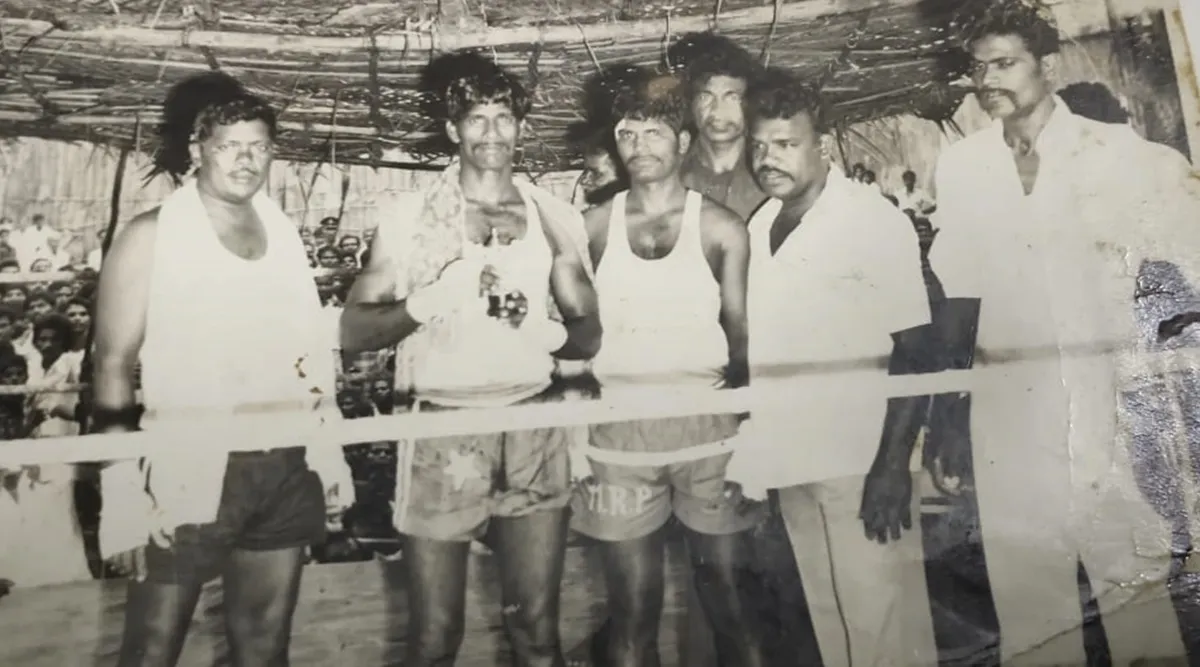
The expansion of the sport birthed the parambarais, neighborhood clans woven together by lineage. Though some suggest these circles were gatekeepers of caste, voices like that of the renowned Baktavachalam offer a different perspective; in a conversation with the Indian Express, he recalled the ring as a site where raw talent dismantled social hierarchies. While no system remains entirely unblemished, the ring historically provided a sanctuary for marginalised and Dalit communities, offering a route to bypass economic hardship, obtain government security through athletic merit, and claim a hard-won dignity.
The golden era of the 1960s and 70s saw the ring at Nehru Stadium glow with the energy of thousands of spectators. It was a thriving ecosystem of prize fighting where contractors brokered bouts that secured the livelihoods of local pugilists. This spectacle of raw discipline captured the imaginations of the political elite and cinematic icons alike; M. G. Ramachandran himself often sat ringside, translating the fierce choreography of these boxers into the dramatic heroics of his on-screen battles.
This stage of supposed meritocracy was ripe for the construction of political narrative. The Dravida Munnetra Kazhagam of the 70s used cinema and sports to communicate their egalitarian and anti-caste ideas to the working class. Political leaders patronised boxing clans to rally youth and channel their aggression constructively. Though its political co-option was eventually the cause for its downfall, the martial arts craze had already made it across the Palk Strait.
Occupation lives in the flesh, insidious and persistent.
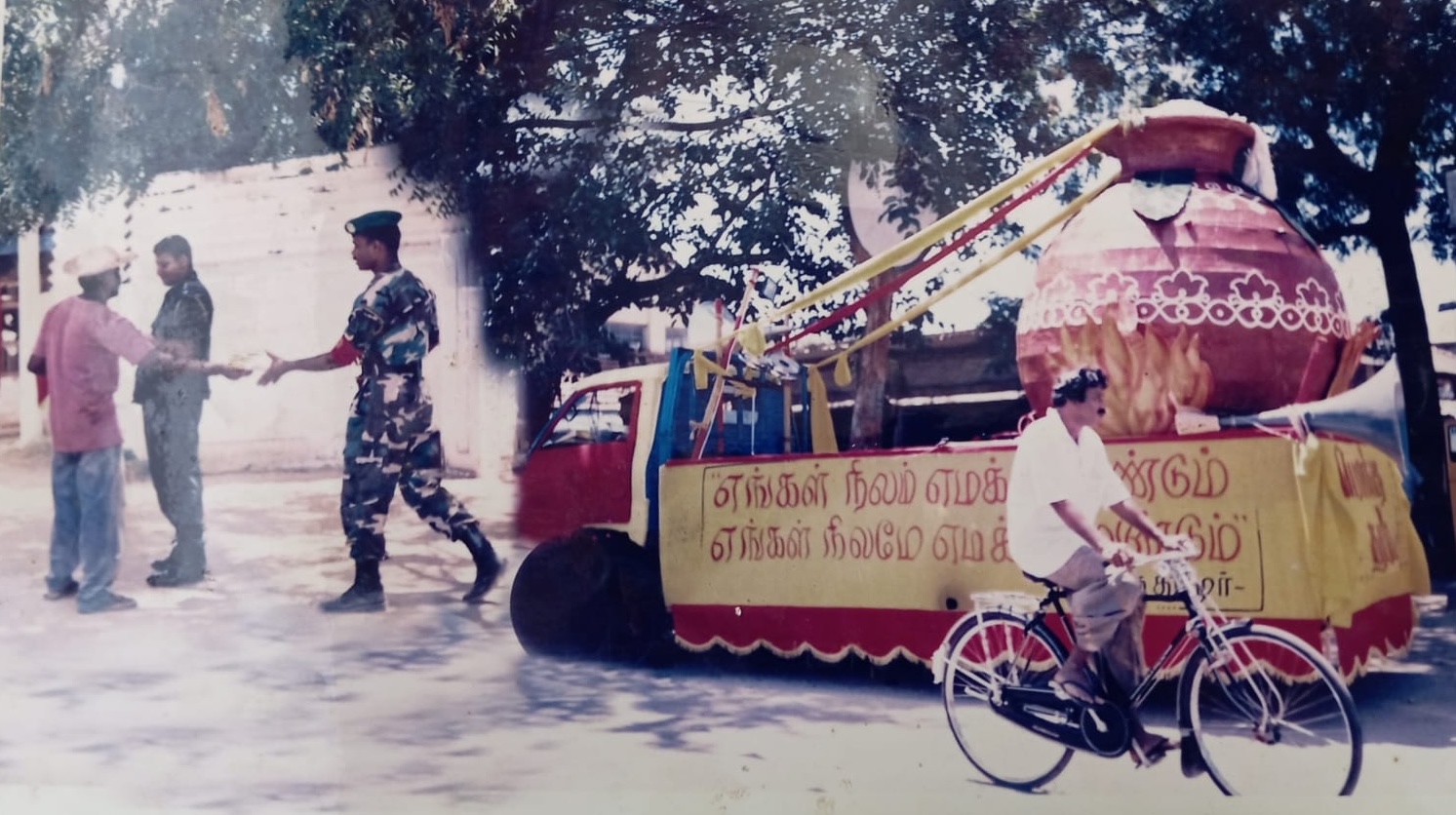
It is a combination of the stories told about you and to you, an oppressive force that enters from the outside. In the pre-80s North-East, it was the quickened heartbeat at the sound of a heavy vehicle slowly driving past, the weathering of tight community ties in the face of panoptic surveillance. Paralysing, it erodes self-determination at the most granular level: the body.
T Uncle’s time with martial arts was short-lived. Interspersed within his many other athletic talents, and the list of sports trophies is admittedly quite lengthy, he turned to karate in a season of great personal helplessness. Like so many others who found a semblance of bodily autonomy in martial arts, he took up the sport in an endeavour of self-defense. Crediting Bruce Lee and the multitude of martial arts films for his attempt, T Uncle says he was born stubborn, he is not one to give up. He tells me with a laugh, and I do not need proof. I see it in the way he recounts his stories, holding eye contact while cutting through raw mutton for curry. In his 60s now, his air of steadiness is one only afforded to those who have been pushed down one too many times, rugged with the wear of time.
To engage in combat sports is an act layered with resistance. It is retorsion against the occupying state, not just as a reclamation of the body, but in the resurrection of a community fractured by intentional policy. He tells me that sports connected athletes across the North-East, opening up new worlds and bridging caste and class lines through brotherhood. All-Ceylon competitions had attendees cheering for participants from across the Tamil homeland, gathering community in the shared name of arts and culture.
The riots of 1977 found many Tamils fleeing to T Uncle’s hometown of Point Pedro and his sports club was mobilised in the efforts to help relocate displaced peoples safely. In a time of growing rowdyism and a restless young adult population, sports like karate helped channel that energy into a discipline oriented towards community service.
He recalls Point Pedro’s lineage of combat sports, those who again traded in silambam for karate, or managed to do both, like his master, R. R master trained many black belts, who then went on to win All-Ceylon competitions. At the turn of the 80s, his notoriety led him into positions of training new Tiger combatants, utilising martial arts techniques towards a new level of liberation.
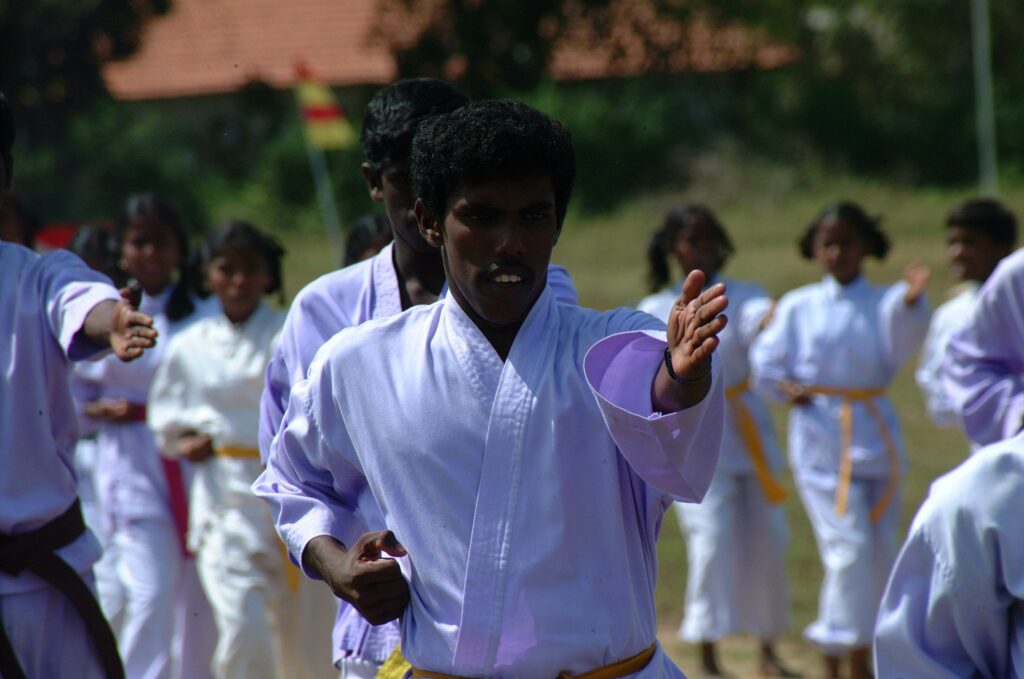
Karate ni sente nashi, or there is no first attack, anchors the philosophy of restraint in karate. True mastery of the art lies in patience, humility, and mental discipline. The use of martial arts to train Tamil fighters is not well-recorded, but it exists. An already rigorous training schedule was supplemented with karate and yoga, to complete the mental transformation of a trainee into a fighter. The same way, for years before, martial arts was used as a channel for civic discipline, the renewal of combat training helped build a foundation of political regulation.
Karate was prolific beyond its use in military training. In 2002, the all-island karate contest found its way to Trincomalee, with members from Vavuniya, Amparai, Nuwara Eliya, and Kandy participating. The Tamil Eelam Sports Festival, inaugurated in 2004, consistently showcased karate skills from across the North-East. In A Fleeting Moment in My Country, N. Malathy writes, “Efforts were made to facilitate every school-going child in attending karate training. Region-wide competitions were conducted for all age groups, and for both males and females.” Among other revolutionary movements of the time, girls of all ages learning martial arts was particularly groundbreaking among Tamils. The impact of all this change was evident across the Tamil homeland. Courage was built on a foundation of stable nationhood, with self-determination slowly assembled, brick by brick, by a people energised with belief.
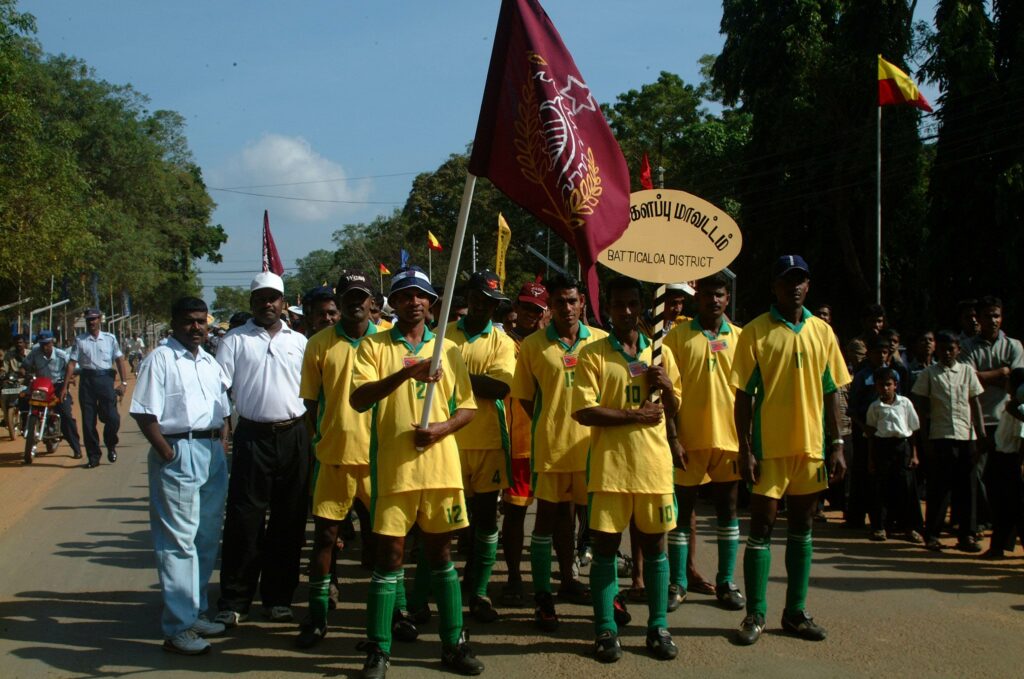
2009, then, was a time of incredible apostasy. As the structures of the nation as we knew it were painfully disassembled, this culture forcibly disappeared along with it. After the end of the conflict, headlines featuring rehabilitation camps plastered websites and newspapers. Officially, around 12,000 ex-combatants, under threat of terrorism charges, went through the government-run disarmament, demobilisation and reintegration (DDR) programme. In the camps, authorities held sports competitions to identify skills for various sports, including cricket, swimming, rifle shooting, and karate. Selected participants were then trained for their respective skill at the Sri Lankan sports academy, often with the objective of joining national sports squads, performing, again, at the behest and control of the state.
Years later, despite all odds, the sport, with all its Tamilness, has found its resurgence.
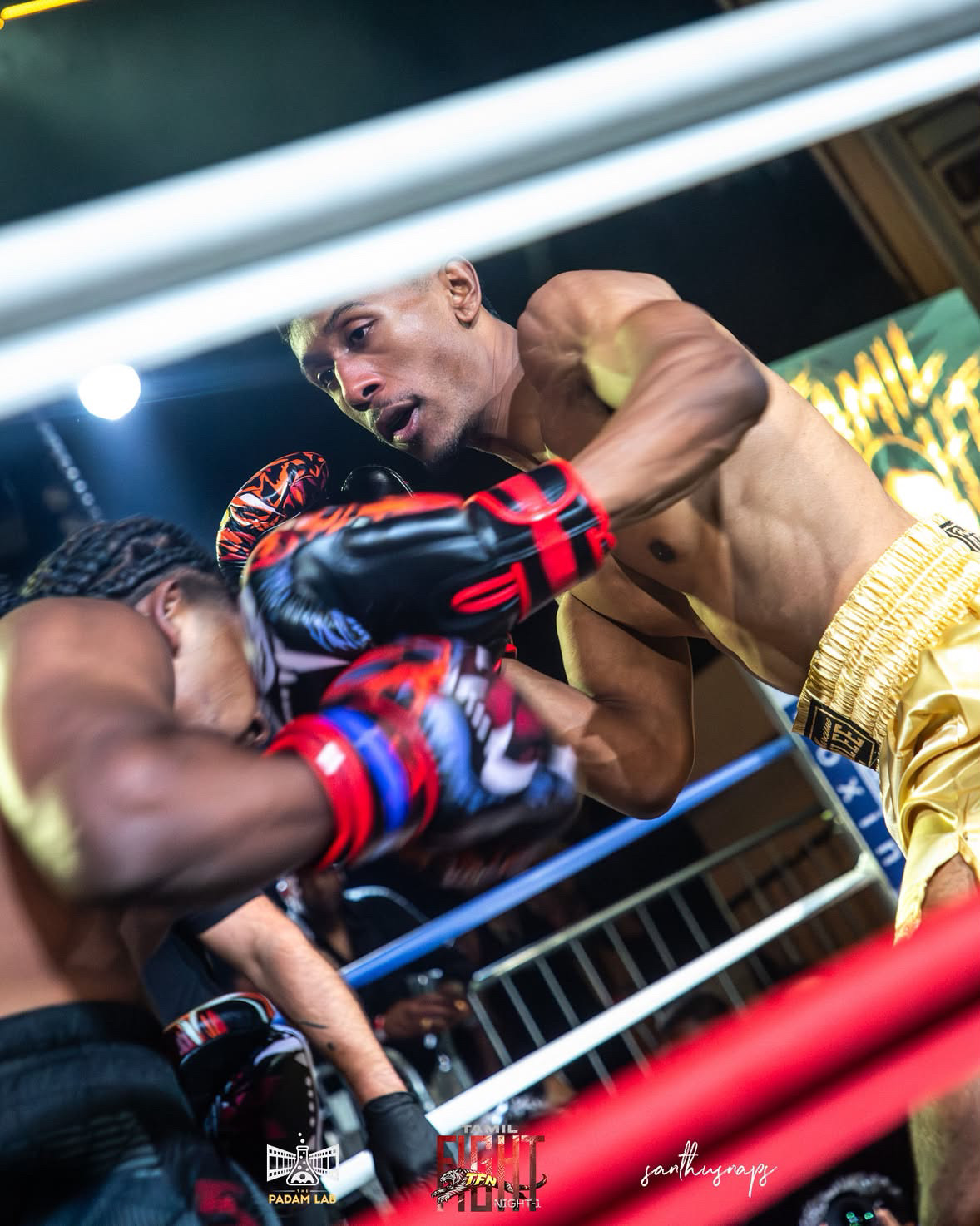
The videos coming out of the first Tamil Fight Night, hosted in London in 2026, are spirited and full of bounce. Each fighter, hailing from across the world, posing for the camera, gloves and boxing shorts splayed with images of tigers, the Eelam flag held high. They make earnest space to honour their ancestry in their performances: Eelam Tamil walkout songs, constant references to fighters, and merchandise with subtle political messaging.
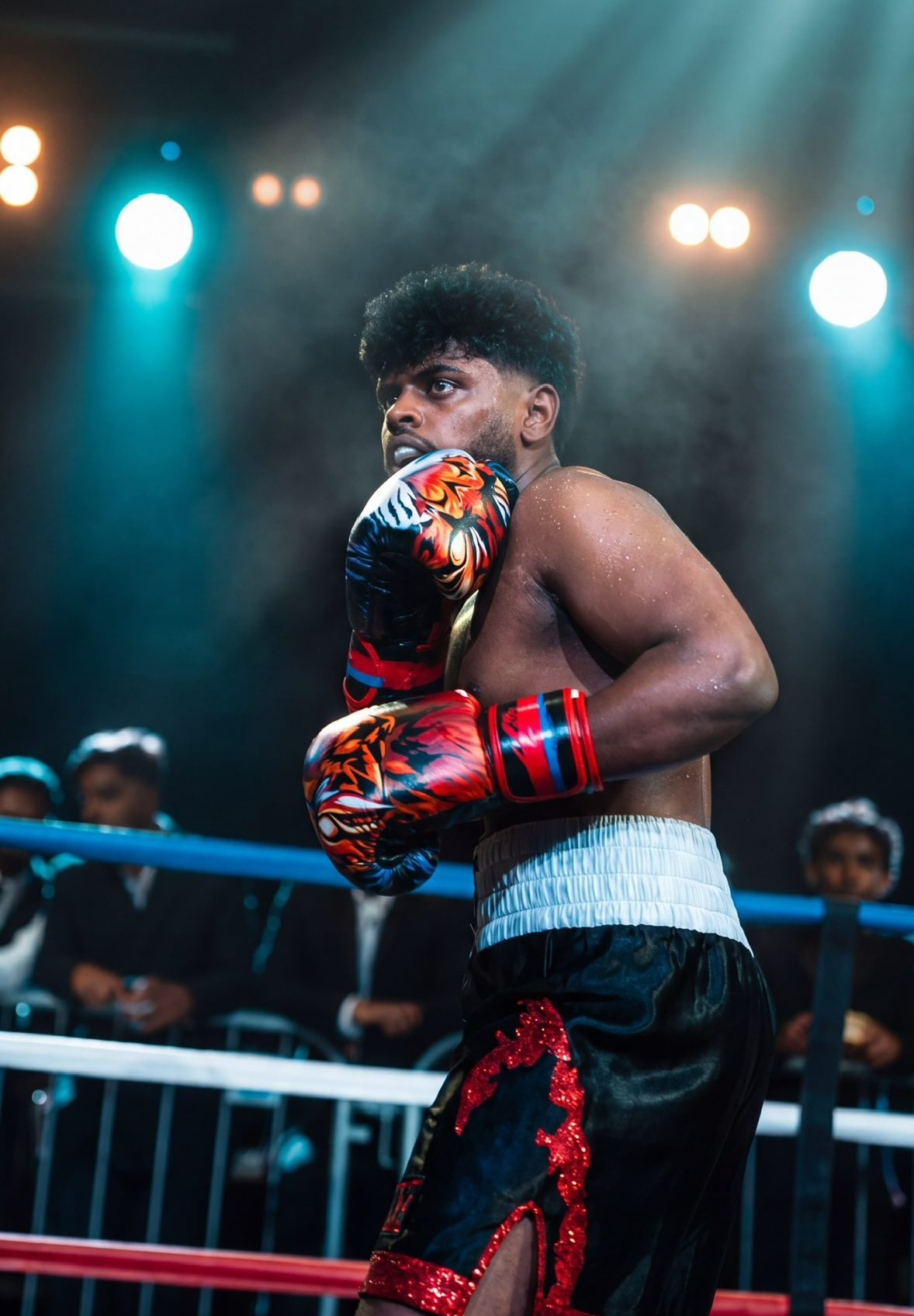
Nithusan, who goes by TTT, or The Tamil Tiger, has a light in his eyes when he talks about his people. It is an expansive devotion that I know well. Growing up in England, he tells me long stories of the debilitating force of racist bullying, of the weakness that becomes inherent when it is all you hear. The stories carry an eerie familiarity; tales that have changed hands and forms, rooting itself into the body of the oppressed, perhaps as old as time. His foray into boxing was motivated by this struggle that he saw as common, and his own singular reclamation of power in the name of his community.
Sujan does not know whether he found boxing or if boxing found him. In some ways, this is true. He credits his entry into the martial arts world with the 2004 Tamil-language film, M. Kumaran, Son of Mahalakshmi, which centres kickboxing in its plot. The strings of fate that placed the movie in front of him, in Germany, were stitched long before he came into this world.
Edwin’s long hair frames his face, no more held tight in the braids from the videos I have grown familiar with. In France, the boxing community is devoid of fighters who look like him. To be Tamil and a fighter is synonymous, to be Tamil is to be a fighter, he says. This Fight Night, surrounded by boxers who look like him, connected not just by language but by shared struggle, is a feeling beyond words.
To be Tamil and a fighter is synonymous, to be Tamil is to be a fighter.
The ring, this time built inside a Tamil-owned banquet hall, is surrounded by men in suits, hollering while fighters take punch after punch. The fine balance between spectacle and skill, between entertainment and exploitation, has plagued boxing for as long as it has existed. For some, it is uncomfortable. To be turned into an exhibition and the object of drunk heckling and slurs, rooted in caste and colour, is exemplary of the wheels of time turning on themselves. For some, it is evidence of a community that has not come far enough, despite the vast separation of time and geography.
For others, this performance is not just about boxing or skill, it is about a platform for the struggle of their people. Sujan tells me that we cannot expect everyone at Fight Night to be there strictly for the love of the sport, rather, his fight is a sacrifice in the pursuit of being heard. There is truth here as well, his platform has reached new heights since his debut, filled with videos on the problems of caste stratification and the Tamil genocide.

Edwin and Sujan at Tamil Fight Night. Photo courtesy of interviewee.
What has also stayed unchanged in the ring are the unwritten rules of brotherhood, of taking a battering followed by polite inquiries of dinner and families – respect that bridges divides, manufactured and otherwise. The experiences of the fighters is an ode to the connection forged across diaspora and borders. It is the newest iteration of resistance against a state that has chained bodies and fabricated fracture through mass displacement.
All three balance boxing alongside school and work, a thankless task, but express unbounded pride at the discipline it has taught them. To get up when pushed down, to hold steady in face of unwavering force that they cite as small, especially relative to the hardships of those that came before them. Though perhaps minor, the fight to grow up, unguided and presented with a torrent of negative influences, throughout the tumultuous childhoods of the first generation refugee is no insignificant feat. Paving their own paths in the face of disapproving communities and families, the inspiration they might pass on is of utmost importance. Sujan tells me of his cousins back home, who have now taken up boxing and have an outlet to mold discipline and focus. For Nithusan, it is not just about standing up for himself, but for a community that needs to continue to believe in self-determination.
For the three of them, the agreement was unanimous: the spirit of the Tamil fighter runs through all of our veins, waiting to be found. In this ring, the past and present collide, boxers who fight on the shoulders of those who came before them, giving life to a revolutionary and resistant legacy. They reclaim a narrative of defiance that has been systematically erased. As they tie their wraps and lace their gloves, they are resurrecting an inheritance, proving that even when a community is fractured, the drive to fight – for dignity, for sovereignty, and for each other – remains unbroken. The squared circle thus stands as a testament to an enduring spirit, one that survives the wreckage of history to land a blow oriented unequivocally for the future.